Janna Jiang, Content
Introduction – What is SAF?
When we think about an industry’s decarbonization potential, we typically first ask the question: “Can it be electrified?” If the answer is no, this is usually labeled a hard-to-abate industry. Aviation – representing ~3% of global greenhouse gas emissions annually, with its high energy density requirements – is one such industry. In the absence of feasible electric aviation at scale, Sustainable Aviation Fuel (SAF) is the best lever we have at our disposal for airline decarbonization, with IATA estimating that 65% of aviation’s pathway to net zero will come from SAF usage.
SAF is a broad term referring to any fuel that can be “dropped in” (more accurately, blended) as a jet fuel replacement, resulting in a reduction in lifecycle carbon emissions – typically a 50–90% reduction in carbon intensity compared to conventional jet fuel. SAF supply pathways differ primarily by feedstock and production method – there are 11 ASTM-approved pathways today, including pack leader HEFA (fuel derived from used cooking oil), ATJ (fuel derived from ethanol or other alcohols), and “eSAF” (synthetic fuel generated using captured carbon and green hydrogen).
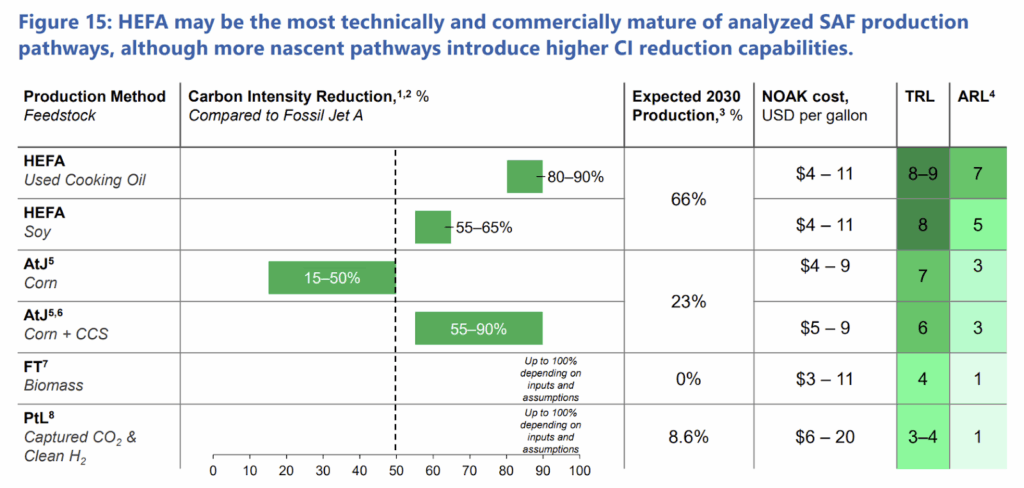
Pathways to Commercial Liftoff, Department of Energy (2024)
State of SAF Today
There are several advantages that SAF enjoys which make it potentially more politically resilient than our resident renewables. One of the major supply pathways is sourced from corn production (which, at least in the US, enjoys large bipartisan support), and many oil & gas refineries and logistics assets can be retrofitted to support SAF production, providing a tangible way for traditional energy companies to participate in the energy transition.
Yet despite these relative political advantages – and the weight of the aviation world on its shoulders – SAF production and consumption have been severely limited. Global production in 2024 represented only ~0.3% of jet fuel use (~350 million gallons), with this number expected to reach ~0.7% in 2025. Airlines for Europe (A4E), a lobby group, recently stated that airlines will not likely be able to meet the EU’s 6% sustainable aviation fuel mandate by 2030 because of a lack of SAF production capacity. Much of this becomes less of a mystery when we reveal the cost: SAF’s Levelized Cost of Fuel (LCOF) is typically 3–10× the cost of conventional jet fuel. In an industry notorious for paper-thin margins, this is not sustainable.
The Case for Book and Claim
How can SAF simultaneously come down the cost curve and attract outside investment or project finance without fear of stranded assets? The only realistic answer is increased bankability through longer-term offtakes. Currently, roughly 50% of signed SAF offtake agreements are one-year contracts, and 70% are under five years (DOE, Pathways to Commercial Liftoff). These are not bankable contracts that provide enough de-risking capacity for cheaper sources of financing to enter and supplement today’s largely VC-, CVC-, or balance sheet–driven capital stacks. This is where Book and Claim comes in.
Book and Claim is a custody model used in commodity industries that separates the actual physical product from its environmental attributes. Applied to SAF, this means that an airline operating entirely in Europe could purchase and claim the environmental attributes of SAF produced and consumed in Brazil. The clean fuel is still burned, providing carbon abatement compared to baseline jetfuel, while the environmental benefit is claimed by the purchasing airline. While a hot topic in aviation lately, this is not a new concept. For example, when you read the headline—“NextEra signs 500 MW clean energy deal with Meta to power new data center”—Meta is not actually receiving physical delivery of the electrons. Electrons go where physics dictates, not where the invoice says. This is the beauty of the Virtual Power Purchase Agreement (VPPA): the offtaker signs a financial contract at a fixed price for electricity from a plant that isn’t co-located with its operations. Meta locks in predictable power pricing, the developer secures a long-term offtake with a blue-chip counterparty that it can present to financiers, and the messy physical delivery is removed from the equation. While not the exact same model (VPPA’s incentive is primarily for price hedging), this procurement mindset can and should transfer to the use of Book and Claim for SAF.
As mentioned earlier, SAF production is heavily dependent on feedstock availability, which is naturally constrained to specific geographies and, for the most part, consists of perishable biogenic products that are difficult to transport. For example, the U.S. and Brazil alone are expected to hold nearly 30% of global biomass feedstock potential for SAF production by 2030 (IATA Global Feedstock Assessment). Yet airlines operate globally, with Asia and Europe leading policy mandates for fuel blending. This geographic mismatch is exactly what the Book and Claim custody model solves.
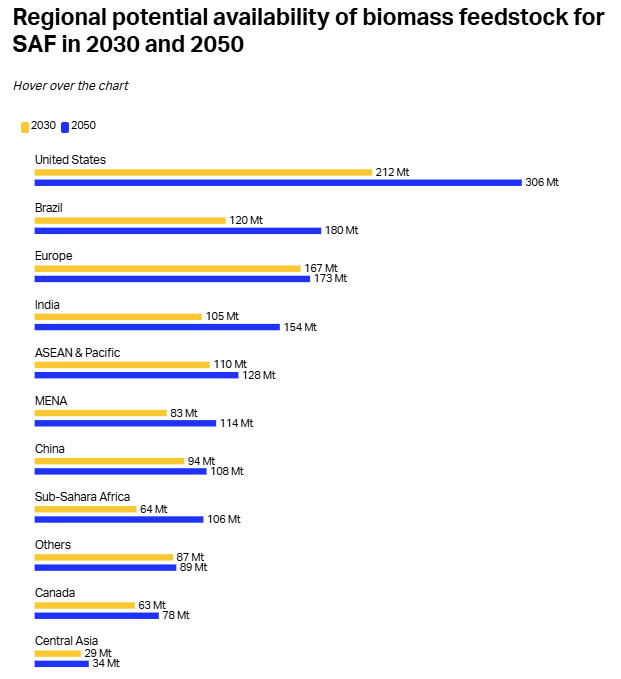
Global Feedstock Assessment for SAF, IATA (2025)
Today, none of the government SAF mandates (e.g., ReFuelEU, CORSIA, or Singapore’s SAF mandate) allow for this ownership model, yet aviation players are moving forward anyway. In 2024, Boeing signed a 7.5 million-gallon SAF offtake with Neste – 4 million gallons delivered physically to Boeing fuel farms and 3.5 million through Environmental Attribute Certificates via Book and Claim. Just last week, DHL, JetBlue, and SAS announced forward demand of ~7 million gallons of SAF to be sourced through Book and Claim. Allowing Book and Claim custody for airline SAF purchases under existing policy frameworks could unlock more – and longer-term – offtake contracts today, accelerating investment, enabling scale, and bringing the cost of sustainable flight closer to Earth.
Sources and Further Reading:
- IATA Global Feedstock Assessment for SAF Production Outlook to 2050
- US Dept. of Energy | Pathways to Commercial Liftoff: Sustainable Aviation Fuel
- Clearing the Path for SAF: Removing barriers and creating incentives: Scaling up Sustainable Aviation Fuel in the EU
- Boeing makes its largest purchase of blended Neste MY Sustainable Aviation Fuel
- Future Energy Global, leading global firms launch SAF pilot