Ishita Date, WG’27
Heat is Half
Heat is half. Heat accounts for about half of total global energy-related emissions. Industrial heat makes up roughly half of that, or around 25% of global emissions. Industrial heat has traditionally been viewed as one of the hardest sectors to decarbonize. Unlike electricity or transportation, heat is rarely seen or measured directly. It happens inside pipes, vessels, and furnaces, which is one reason it has received less attention despite its scale.
However, heat is required to make the basic materials that underpin modern life. These range from low-temperature processes like heating milk enough to kill harmful bacteria, to extremely high-temperature processes such as driving CO₂ out of limestone to produce cement.
How to think about Industrial Heat
Heat is a service, not a fuel. What matters for industrial processes is not how heat is generated, but whether it meets the required temperature, timing, and reliability. In practice, heat demand is most commonly segmented by temperature. Industrial heat demand spans a wide range of temperatures across different industries.
Illustration of the temperatures that different industries need (EPA):
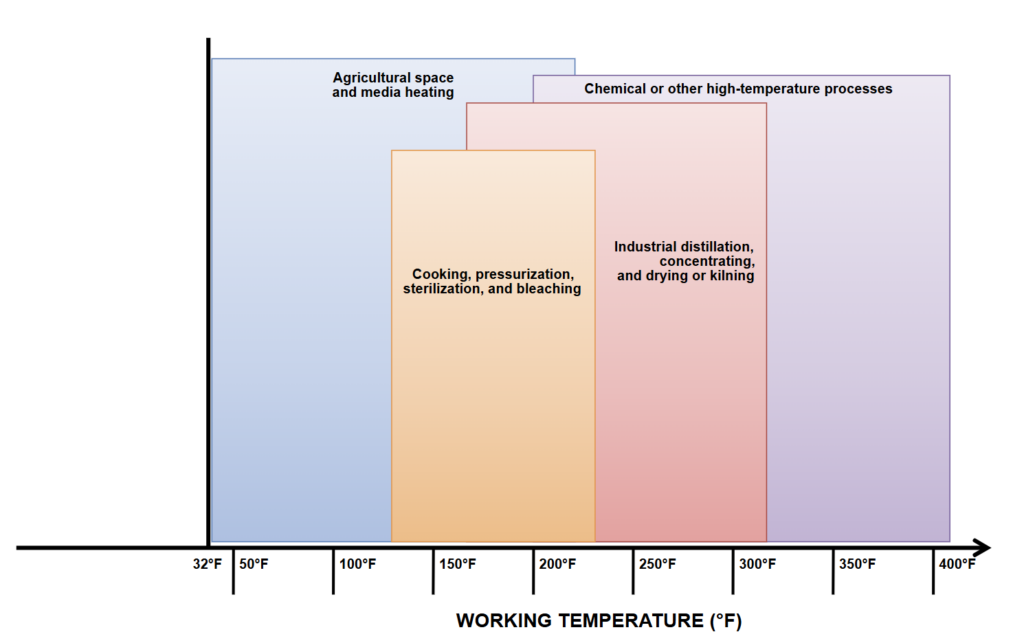
Low-temperature heat, roughly 0–200°C (32 – 392°F), serves sectors such as food and beverage processing, pulp and paper, textiles, and pharmaceuticals. Medium-temperature heat, between 200°C – 500°C (392 – 932°F), is typical in industries like chemicals, refining, and certain materials processing activities. High-temperature heat, above 500°C (932°F+), is concentrated in heavy industries including cement, steel, and glass.
What role does steam play?
When people refer to industrial heat, they are usually actually talking about steam. Steam functions like a currency for moving heat, allowing energy captured in one process to be delivered to another. In many industrial settings, fossil fuels are used to heat water and generate steam, which is then distributed throughout a facility to provide process heat. Steam can transfer a large amount of heat at constant temperature in a relatively small amount of matter, enabling efficient transport of heat across a facility. Combined with the fact that it is non-toxic, abundant, and relatively inexpensive, this explains why steam has become so deeply embedded in industrial operations.
What has changed that makes this once “hard-to-abate” sector now abatable?
Historically, it has been easier and cheaper to burn fuels to create steam. The total cost of most industrial heating systems is dominated by variable, rather than fixed costs, the largest of which is typically natural gas. The dramatic cost reductions in solar and wind have made intermittent renewable electricity highly competitive. However, cheap power does not mean usable power. Industrial heat demand is largely continuous, while renewable electricity supply is intermittent. Most industrial processes cannot economically ramp up and down in response to the availability of wind or sunlight, creating a structural mismatch between supply and demand. A growing set of companies is focused on bridging this gap.
Renewable technologies we are excited about
The strongest early opportunities in renewable heat lie in low-temperature applications, where some solutions are already commercially viable. As these technologies mature at lower temperatures, they are being adapted to operate at progressively higher temperature ranges.
High-temperature heat pumps
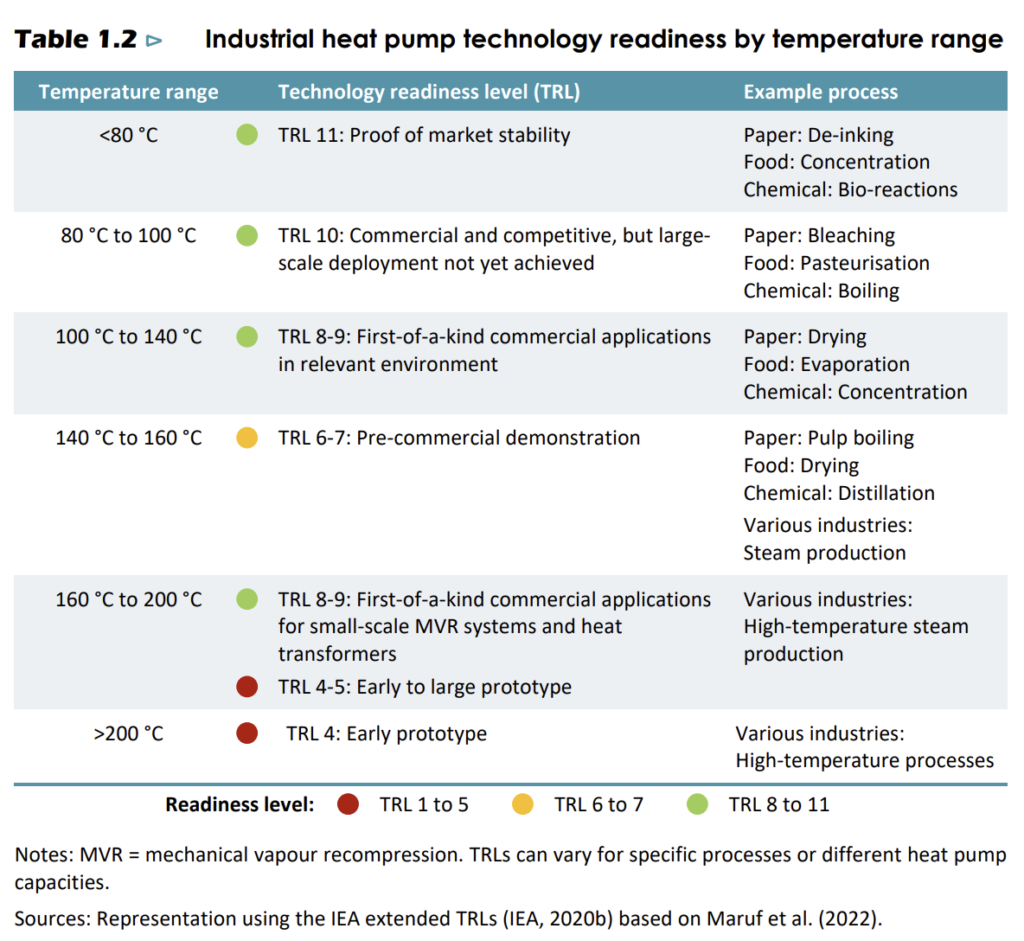
While heat pumps have been deployed for decades, new designs have expanded their ability to operate at industrial-grade temperatures. The core technology is the same across temperatures: instead of generating heat, heat pumps transfer it. They extract thermal energy from sources such as outside air, geothermal, or industrial waste heat and upgrade it for productive use. Commercial viability today is strongly temperature-dependent, with readiness levels declining as operating temperatures increase.
Current state of industrial heat pump technology (IEA):
Thermal Batteries
CEO of Antora Energy (explained further in our podcast The Current) Andrew Ponec aptly described thermal batteries as “being like toasters”: electricity heats internal coils, which then deliver heat in a controlled way to make toast. In this case, solar or wind energy is used to generate heat that warms a storage medium, allowing that heat to be released steadily for later consumption. This approach takes advantage of cost-favorable periods when the grid is curtailing energy, making it especially effective in utilities with modernized rate structures. Many companies are experimenting with different storage materials – Rondo Energy and Electrified Thermal Solutions use bricks, Malta relies on molten salt, Brenmiller Energy uses crushed rocks, and Antora Energy stores heat in carbon, to name a few.
At the Wharton Energy Club’s annual SF trek, Nehali Jain, Antora Energy’s VP of Strategy & Growth (and Wharton alum!), demonstrates a model of their battery:

Conclusion
Industrial heat is large, essential, and diverse. As costs shift and new technologies mature, decarbonization is becoming increasingly viable across a growing share of industrial processes. The transition underway in industrial heat mirrors the shift from blast furnaces to electric arc furnaces (EAFs) in steel. EAFs succeeded not by changing the end product, but by changing the source and controllability of heat. Heat pumps represent an evolution of existing industrial heating technology, increasing efficiency by transferring and upgrading heat, while thermal batteries take a more structural approach, creating a new class of infrastructure that converts intermittent electricity into reliable, on-demand heat. The decarbonization of industrial heat is moving from theoretical to practical as new technologies reshape how heat is delivered.
Images
Sources and Further Reading
- Latitude Media – Solving the Conundrum of Industrial Heat
- DOE – Industrial Decarbonization Liftoff Report
- World Economic Forum – Heat Here’s Why Its the Elephant in the Room for Decarbonization
- NREL – High-Temperature Heat Pump Model Documentation and Case Studies
- IEA – The Future of Heat Pumps
- MIT Technology Review – How Thermal Batteries are Heating up Energy Storage
- Renewable Thermal Collaborative – Thermal Battery Report
- Canary Media – This Startup’s Energy Storage Tech is Essentially a Giant Toaster